Can weight stigma trigger inflammation? A study breakdown
February 9, 2026
Weight stigma gets dismissed as “just words” or “people being too sensitive.”
But your body doesn’t separate emotional stress from physical stress as neatly as we’d like.
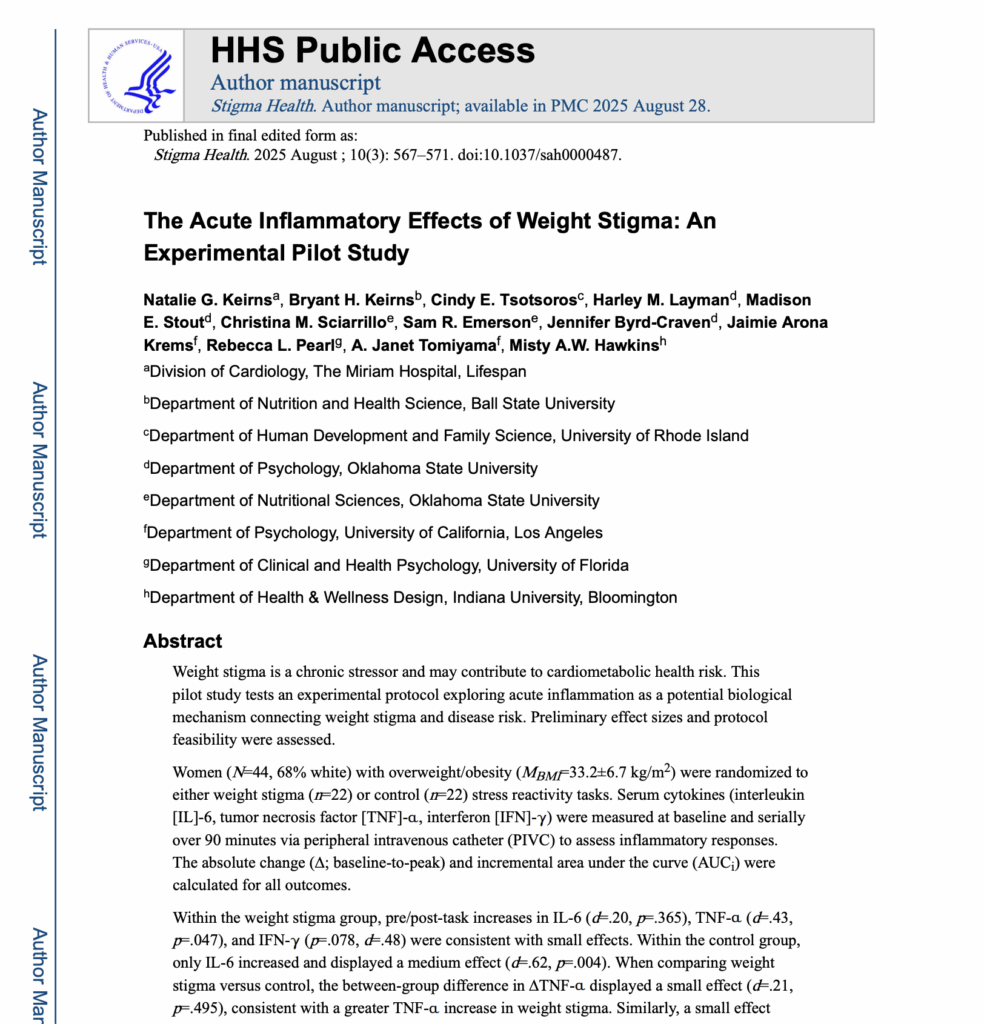
A pilot experimental study by Keirns and colleagues explored whether weight stigma can trigger an acute inflammatory response in the body.
Here’s what they did, what they found, and what we can realistically take from it.
Why would weight stigma affect inflammation?
Weight stigma is a stressor. Stress activates systems designed to help you respond to threat. One downstream effect can be shifts in inflammatory signalling.
Inflammation isn’t automatically “bad.” It’s part of immune function and recovery. The issue is when stressors are repeated or chronic and keep the system switched on more than it needs to be.
The research question
The researchers asked: does a weight-stigma stress task cause short-term increases in inflammatory cytokines?
They also wanted to test whether this kind of lab protocol is feasible for larger studies.
Who participated
- 44 women
- Average BMI around 33
- Randomised into two groups:
- weight stigma stress task
- control stress task
What they measured
They tracked three inflammatory cytokines in blood samples taken across 90 minutes:
- IL-6
- TNF-α
- IFN-γ
They used repeated sampling via an IV catheter to make the process more practical and reduce multiple needle sticks, and they calculated change scores and area-under-the-curve measures to reflect the overall response.
What they found
Because it was a pilot study with a small sample, there were no statistically significant between-group differences overall.
But the pattern of effects was still notable:
- In the weight stigma group, the inflammatory markers showed small-to-moderate effect size increases, especially TNF-α and IFN-γ.
- In the control group, IL-6 increased with a medium effect.
The authors conclude that the results warrant larger studies and that the protocol is workable to repeat on a bigger scale.
Limitations you should know before sharing this study
If you’ve been around All Bodies content for a while, you know we don’t do black-and-white claims. This study has clear limits:
- It’s a pilot study. Small sample sizes make it hard to detect between-group differences even if real effects exist.
- Participants completed ~45 minutes of cognitive testing before the stigma task, which could have already influenced stress and inflammatory responses.
- It included women only, so we can’t assume identical patterns in other groups.
What this means for sport, coaching, and healthcare
This paper doesn’t say “higher weight causes inflammation.”
It suggests something more uncomfortable and more actionable:
Stigma itself may be part of the stress load.
In sport and in clinical settings, weight stigma can show up as:
- performative “health” comments
- weigh-in culture
- jokes framed as banter
- oversimplified nutrition advice
- assumptions about willpower
Even when the intention is “motivation,” the impact can be threat, shame, and stress. And for some people, that stress may come with measurable physiological changes.
Practical takeaway
If you’re a coach, clinician, or athlete:
- Treat weight-stigma reduction as part of performance support and health support.
- Audit your language and your systems (weigh-ins, body comments, “before and after” culture).
- Build psychological safety. It’s not soft. It’s strategic.
Reference
Keirns NG, et al. The Acute Inflammatory Effects of Weight Stigma: An Experimental Pilot Study. Stigma and Health. (Epub 2023; published 2025).

Be the first to comment