ADHD, Autism and AuDHD in Eating Disorder Treatment: What New Research Shows
August 27, 2026
If you’re autistic, an ADHDer, or both, and you’ve been through eating disorder treatment, you may have noticed that the standard approach doesn’t quite fit. Maybe the sensory environment of a program made things harder, not easier. Maybe you felt unseen because no one ever asked about your neurodivergence in the first place, let alone factored it into your care.
A new study, published in Frontiers in Psychiatry, backs up what a lot of neurodivergent people in eating disorder treatment have been saying for a while: neurodivergence changes what recovery looks like, and it’s still not being routinely picked up on at intake. Here’s what the study actually found, and what it means in practice.
What the researchers did
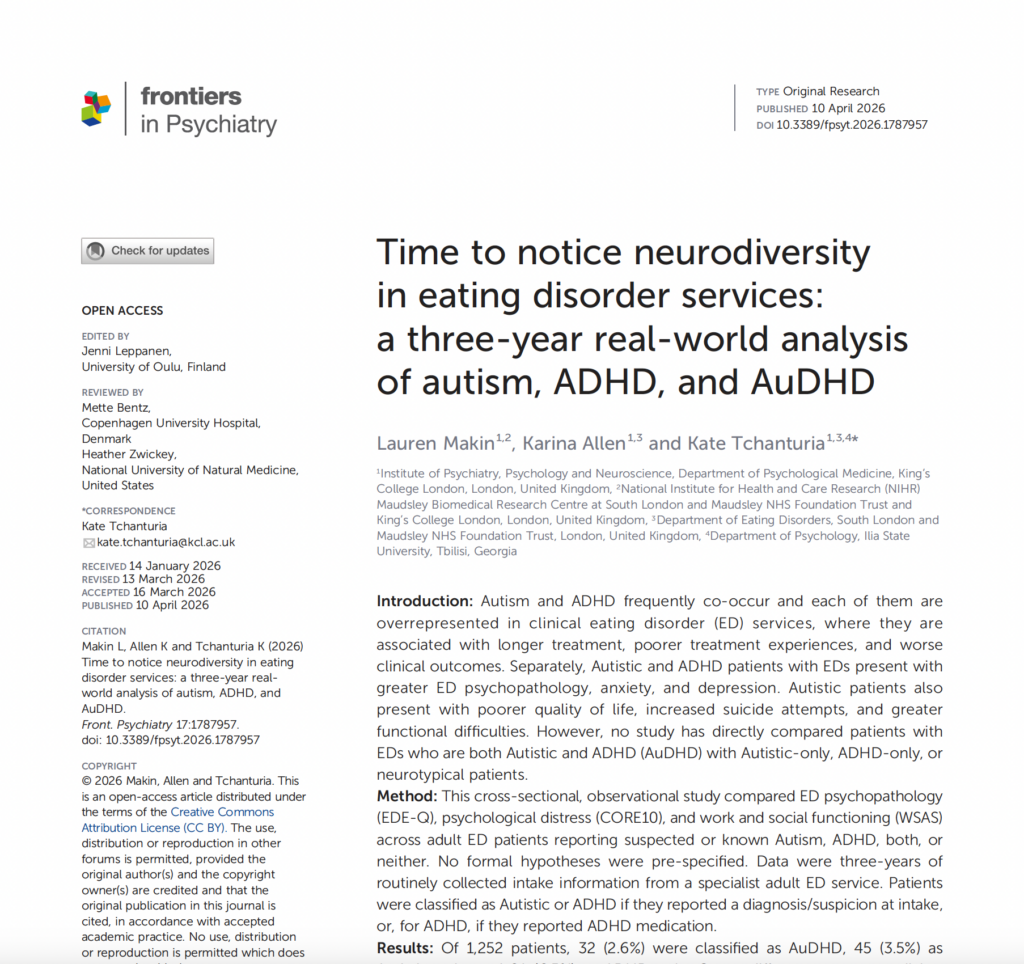
This was a cross-sectional study, which means it looked at a snapshot of people at one point in time rather than following them over months or years. That’s an important distinction, because it means the study can show that certain patterns turn up together, but it can’t tell us that one thing causes another.
The researchers used three years of routine intake data from a specialist adult eating disorder service in the UK, covering 1,252 patients between December 2022 and August 2025. At intake, patients were grouped based on whether they reported being autistic, having ADHD, both (referred to in the study as “AuDHD”), or neither:
- 32 patients (2.6%) reported being both autistic and having ADHD
- 45 patients (3.5%) reported being autistic only
- 81 patients (6.5%) reported having ADHD only
- The remaining 1,094 patients (87.4%) reported neither
It’s worth flagging straight away that these numbers are almost certainly an undercount. Neurodivergence status was based on what people had already been told, self-identified, or spontaneously mentioned at intake, not on a formal diagnostic assessment carried out for the study. Plenty of autistic and ADHD people, especially those who are AuDHD, aren’t diagnosed until later in life, if at all, and many won’t disclose or even recognise their neurodivergence in a first appointment with a new service. The researchers acknowledge this as a limitation, and it lines up with what neurodivergence-affirming eating disorder services generally see: prevalence figures based on self-report at intake tend to sit well below what’s found when services actively screen for autism and ADHD.
Patients were compared on three measures already in common clinical use: the EDE-Q (a standard questionnaire for eating disorder symptoms), the CORE-10 (a measure of general psychological distress), and the WSAS (a measure of how much difficulty someone is having with work, study, and social life).
What they found
Three patterns stood out.
ADHD alone was most strongly linked to eating disorder symptom severity. People in the ADHD-only group had the highest EDE-Q scores of any group, higher even than the AuDHD group. The researchers suggest this fits with what’s already understood about ADHD and impulsivity, since impulsivity is closely tied to binge eating and other less-planned eating behaviours, whereas autistic traits tend to relate more to restriction and rigidity around food.
AuDHD was linked to the highest psychological distress and the poorest day-to-day functioning. People who were both autistic and had ADHD scored highest on the CORE-10 (distress) and the WSAS (functioning), meaning they were, on average, struggling the most with daily life, work, study and relationships, and reporting the most general psychological distress, not just eating disorder symptoms. This group also had a notably higher rate of reported past suicide attempts (over half, compared with around a quarter of the group with neither condition), which underlines how much broader support this group may need beyond food and eating alone.
The differences were consistent but small. It’s important to be honest about the size of these effects. Statistically, the differences between groups were small. This was a clear, consistent pattern across the sample, not a dramatic split between distinct types of people. All groups, including those with neither autism nor ADHD, showed clinically significant distress and eating disorder symptoms, because after all, everyone in the sample was accessing specialist eating disorder treatment.

Taken together, the findings suggest autism and ADHD affect eating disorder presentation in different ways. ADHD tracks more closely with how severe the eating disorder symptoms themselves are, while having both conditions together tracks more with how much someone is struggling more broadly, in their mood, their functioning and their sense of coping.

What this means in practice
The study’s authors argue that eating disorder services would benefit from routinely screening for autism and ADHD at intake, using brief validated tools, rather than relying on people to bring it up themselves. Given how under-detected neurodivergence appears to be in this sample compared to general population estimates, that seems like a reasonable conclusion.
This doesn’t mean neurodivergent people need an entirely different treatment model from everyone else, and it’s not a suggestion that eating disorders present in a fundamentally different way in neurodivergent people. What it does suggest is that clinicians should expect more complexity and more distress in this group, and adjust their support accordingly. In practice, that might look like more flexibility around sensory needs and communication style, more explicit and less assumed structure in sessions, direct executive function support around things like meal planning and appointment follow-through, and being alert to the higher risk profile the AuDHD group showed in this study.
If you’re autistic, have ADHD, or are AuDHD, and you’ve had a hard time with eating disorder treatment that didn’t seem to account for how your brain works, this research is a useful piece of evidence that it wasn’t just you. The mismatch between generic treatment models and neurodivergent needs is something researchers and clinicians are only starting to properly measure and respond to.
A note on what this study can’t tell us
Because this was a cross-sectional, observational study relying on self-reported neurodivergence, it can’t tell us how many people in eating disorder services are actually autistic or have ADHD, since the true number is likely higher than what was captured here. It also can’t tell us whether the eating disorder came first, whether the neurodivergence went unrecognised for years and shaped how the eating disorder developed, or how the two interact over time. Those are questions that would need different kinds of research, following people over time and using formal diagnostic assessment.
What it does add to the evidence base is a large, real-world sample showing that neurodivergent traits, even self-reported and likely underdetected, are associated with meaningfully different presentations in eating disorder treatment. That’s a solid basis for services to start asking the question at intake, even before more definitive research comes through.
Getting support that actually fits
If any of this sounds familiar, whether you’re autistic, have ADHD, are AuDHD, or you’re just not sure but suspect your brain works differently to what standard treatment expects, you don’t have to keep adapting yourself to a model that wasn’t built with you in mind. At All Bodies Services we offer neurodivergent-affirming, weight-inclusive eating disorder support, both in person in East Brisbane and via telehealth across Australia. If you’d like to talk through what support could look like for you, you’re welcome to book a discovery call.
You may also be interested in



Reference
[1] Time to notice neurodiversity in eating disorder services: a three-year real-world analysis of autism, ADHD, and AuDHD. Frontiers in Psychiatry. 2026. DOI: 10.3389/fpsyt.2026.1787957

Be the first to comment